
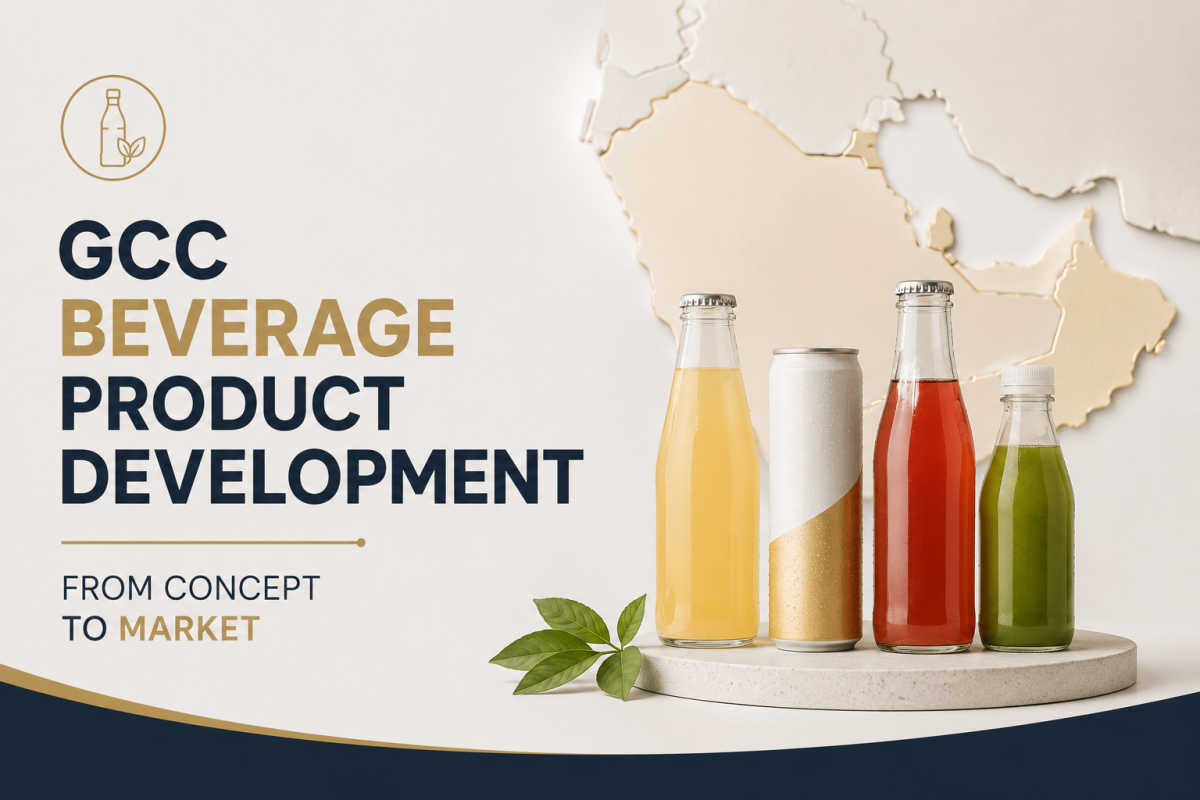
The Gulf Cooperation Council (GCC) offers significant opportunities for businesses developing and launching food and beverage products. The region includes the UAE, Saudi Arabia, Qatar, Kuwait, Oman, and Bahrain, creating access to multiple markets with consumers who are familiar with both international and regional beverage brands.
However, developing a beverage for the GCC requires more than creating a product that works in one market. Businesses need to consider consumer preferences, flavour profiles, pricing, packaging, manufacturing, regulations, product claims, and the requirements of individual countries.
This makes GCC beverage product development a specialised process that connects product innovation with regional commercial planning.
Whether the concept is a functional drink, wellness beverage, energy product, juice, flavoured water, sports drink, botanical beverage, or another ready-to-drink product, careful development can help create a stronger foundation for GCC expansion.
What Is GCC Beverage Product Development?
GCC beverage product development is the process of creating and preparing a drink specifically for commercial opportunities across Gulf markets.
It can include:
- Market and consumer research
- Beverage concept development
- Ingredient research
- Recipe and formulation
- Flavour development
- Prototype testing
- Stability considerations
- Packaging development
- Brand development
- Manufacturing
- Regulatory preparation
- Product launch
- Buyer and distributor connections
The goal is to create a beverage that is not only appealing to consumers but also commercially practical and capable of being adapted to different GCC markets.
Why Develop a Beverage for the GCC Market?
The GCC provides opportunities for both local startups and international businesses looking to expand.
However, consumers across the region are not one single market. Preferences, retail environments, regulations, pricing, and distribution structures can differ between countries.
A beverage intended for GCC expansion should therefore be developed with regional scalability in mind.
For example, a brand may begin in the UAE and later expand into Saudi Arabia, Qatar, Kuwait, Oman, or Bahrain. If regional expansion is considered from the beginning, decisions around formulation, packaging, branding, manufacturing, and documentation can be made with future markets in mind.
Key Stages of GCC Beverage Product Development
1. Market Research and Consumer Analysis
The first stage is understanding where the opportunity exists.
Research can examine:
- Consumer preferences
- Beverage categories
- Competitor products
- Pricing
- Packaging formats
- Flavour trends
- Retail channels
- Functional beverage opportunities
- Potential market gaps
Research can also help identify whether a product should target the mass market, premium consumers, health-conscious customers, athletes, younger consumers, families, or another specific audience.
A clear target audience makes later decisions about formulation, flavour, packaging, and branding easier.
2. Beverage Concept Development
Once the opportunity has been identified, the concept needs to be clearly defined.
A beverage concept may establish:
- Product category
- Target consumer
- Functional purpose
- Flavour direction
- Ingredient profile
- Packaging format
- Price positioning
- Brand personality
- Intended markets
For example, a hydration beverage designed for active consumers will require different product decisions from a premium botanical drink intended for hotels and restaurants.
The concept should provide a clear reason for consumers to choose the product.
3. Recipe and Beverage Formulation
The formula is at the centre of product development.
Depending on the beverage, formulation may involve fruit ingredients, flavours, sweeteners, acids, vitamins, minerals, electrolytes, botanicals, functional ingredients, stabilisers, or other suitable components.
The challenge is making these components work together.
An ingredient may provide functionality but introduce bitterness. A sweetener may reduce sugar but affect aftertaste. A botanical ingredient may create an attractive proposition but influence colour or stability.
Professional formulation aims to balance:
Taste + Functionality + Stability + Cost + Scalability
Branding Innovations supports recipe development through ingredient research, sample creation, flavour development, and refinement, helping businesses move from an initial concept toward a commercially developed beverage.
4. Flavour Development
Flavour is particularly important when developing beverages for a broad regional audience.
A product may need to feel familiar enough for consumers to understand while offering something distinctive enough to stand out.
Flavour development can assess:
- Sweetness
- Acidity
- Aroma
- Flavour intensity
- Mouthfeel
- Aftertaste
- Overall drinking experience
For functional beverages, flavour development can become even more important because certain vitamins, minerals, botanicals, or other functional ingredients can introduce strong sensory characteristics.
A well-developed flavour can help turn an innovative concept into a beverage consumers want to purchase repeatedly.
5. Prototype Testing and Refinement
The first formula is rarely the final formula.
Prototype development allows the team to assess the beverage and identify areas that require improvement.
Testing may involve comparing different ingredient levels, flavour combinations, sweetness levels, or functional components.
The process can continue through several rounds until the product meets the desired sensory and technical objectives.
This stage also provides an opportunity to identify potential problems before the beverage reaches commercial manufacturing.
Commercial Scale-Up for GCC Beverage Brands
A beverage that works in a small development batch may behave differently during large-scale production.
Commercial manufacturing introduces different:
- Production volumes
- Mixing equipment
- Processing conditions
- Filling systems
- Storage conditions
- Transportation requirements
Ingredients may separate, flavours may change, or texture and colour may behave differently at scale.
This makes commercial scale-up an important part of GCC beverage product development.
Manufacturing costs should also be considered early. Ingredient selection, packaging, production volumes, minimum order quantities, and logistics can all influence the final product cost.
A successful beverage needs to be desirable to consumers while also making sense commercially.
Packaging for GCC Beverage Markets
Packaging is another important part of regional product development.
A beverage may need to compete in supermarkets, convenience stores, cafés, restaurants, hotels, gyms, e-commerce platforms, and other channels.
Packaging needs to balance:
- Brand identity
- Consumer appeal
- Product information
- Practicality
- Manufacturing requirements
- Transportation
- Shelf presentation
Bottle, can, carton, and other formats can be considered according to the product and intended market.
A strong packaging system can also make future product extensions easier. Once the core brand identity is established, additional flavours or beverage formats can be developed within the same visual system.
GCC Regulatory Considerations
One of the most important aspects of regional beverage expansion is understanding that GCC markets have both shared frameworks and country-specific requirements.
GCC food and beverage compliance can involve areas such as:
- Ingredients
- Labelling
- Nutritional information
- Product claims
- Shelf life
- Packaging
- Product registration
- Import documentation
Guidance on GCC food and drink regulations highlights the importance of understanding GSO standards alongside the requirements of national authorities, particularly for ingredients, labelling, claims, shelf life, and documentation.
This means businesses should not assume that approval or registration in one GCC country automatically means that every requirement has been satisfied across the region.
Professional regulatory advice should be obtained for the specific product and target markets.
Sugar and Sweetener Considerations
Sugar levels can also become important when developing beverages for GCC markets.
The UAE introduced a tiered volumetric excise-tax model for sweetened beverages from 1 January 2026, with taxation linked to sugar and other sweetener content per 100 ml. The UAE Federal Tax Authority describes this approach as aligned with the GCC Unified Excise Tax Agreement.
Saudi Arabia has also introduced a sugar-content-based excise system for sweetened beverages in 2026.
These developments demonstrate why formulation decisions should be considered alongside commercial planning when developing products intended for regional markets.
For products entering multiple GCC countries, businesses should check the current requirements applicable in each target market rather than relying on one country’s classification.
Branding a Beverage for GCC Consumers
A strong beverage needs more than a technically sound formula.
The brand should communicate its proposition clearly and create an identity that can work across the intended markets.
Brand development can include:
- Brand naming
- Logo
- Visual identity
- Packaging design
- Brand messaging
- Product positioning
- Communication style
The identity should be culturally appropriate while remaining distinctive and commercially flexible.
For example, a premium wellness beverage may use sophisticated packaging and messaging, while a sports hydration product may require a more energetic visual identity.
The branding should always reflect the actual product and target audience.
Why Choose Branding Innovations for GCC Beverage Product Development?
Developing a beverage for regional markets can involve many different specialists. Working with a development partner that connects several stages of the process can make the journey more structured.
Branding Innovations specialises in beverage development and branding and provides support across research, recipe development, branding, packaging, manufacturing, product launch, and buyer connections. Its website states that the company has developed and launched more than 200 food and drink brands worldwide.
End-to-End Beverage Development
Branding Innovations brings product development and branding together rather than treating formulation and brand creation as completely separate projects.
This allows businesses to consider the relationship between the beverage, packaging, positioning, manufacturing, and launch from an early stage.
Recipe Development Expertise
The company supports businesses with ingredient research, recipe development, sample creation, and flavour refinement.
This can be particularly useful for businesses developing functional, wellness, or innovative beverage concepts.
Branding and Packaging Support
The beverage needs to communicate its value effectively in competitive retail environments. Branding Innovations supports the development of brand identity and packaging alongside the product.
Manufacturing Connections
Moving from an approved formula to commercial production requires suitable manufacturing partners.
Branding Innovations highlights its network of co-packers and suppliers as part of its wider beverage development and launch support.
Buyer Connections
Product development ultimately needs to lead toward market opportunities. Branding Innovations states that its proprietary database includes more than 6,500 buyers, including retailers, wholesalers, and distributors.
This can help connect beverage development with potential commercial opportunities.
Common GCC Beverage Development Mistakes
Treating the GCC as One Identical Market
The GCC is a regional market, but individual countries have their own consumer preferences and regulatory requirements.
Developing Without Regional Expansion in Mind
If GCC expansion is a long-term goal, formulation, packaging, branding, and documentation should be considered accordingly.
Focusing Only on the Recipe
A good formula is important, but branding, packaging, manufacturing, pricing, and distribution also affect commercial success.
Ignoring Manufacturing Costs
Ingredient and packaging choices can significantly influence the final cost of the beverage.
Leaving Compliance Until the End
Regulatory considerations should be reviewed during product development rather than after the product is finalised.
FAQs About GCC Beverage Product Development
What is GCC beverage product development?
It is the process of developing a beverage with the intention of launching or expanding it across GCC markets. It can include research, formulation, flavour development, testing, branding, packaging, manufacturing, and market launch.
Which countries are included in the GCC?
The GCC consists of the United Arab Emirates, Saudi Arabia, Qatar, Kuwait, Oman, and Bahrain.
Can a beverage developed in the UAE be sold across the GCC?
Potentially, yes, but each target country may have its own registration, labelling, import, ingredient, claims, and other requirements. Products should be reviewed for each market before expansion.
How long does GCC beverage product development take?
The timeline depends on the beverage category, formulation complexity, prototype testing, packaging, manufacturing, regulatory requirements, and the number of target markets.
Can an existing beverage recipe be developed for GCC markets?
Yes. An existing recipe can be refined and assessed for taste, stability, commercial production, packaging, and the requirements of intended GCC markets.
Can functional beverages be developed for the GCC?
Yes. Functional beverages can be developed around areas such as hydration, energy, wellness, vitamins, minerals, botanicals, and other functional ingredients, subject to applicable requirements.
Conclusion
GCC beverage product development requires a broader approach than simply creating a drink recipe. A successful regional beverage needs to combine consumer insight, formulation, flavour, stability, packaging, branding, manufacturing, compliance, and commercial planning.
Businesses looking to expand across the Gulf should consider regional requirements from the beginning rather than developing a product for one market and attempting to adapt it later.
With an integrated development process, a beverage can move from concept and formulation to branding, manufacturing, launch, and potential GCC market expansion.
Branding Innovations provides support across these stages, helping businesses connect beverage innovation with branding, production, launch, and buyer opportunities as they build products for the UAE and wider GCC market.
About Richard Horwell
Richard Horwell has been behind more than 200 food and drink brands worldwide during the past 20 years, supporting projects from market research and recipe development through branding and production. His approach is built around innovation rather than imitation and honest guidance about the risks of launching a new brand. Next step: Discuss your beverage idea with the UAE team