
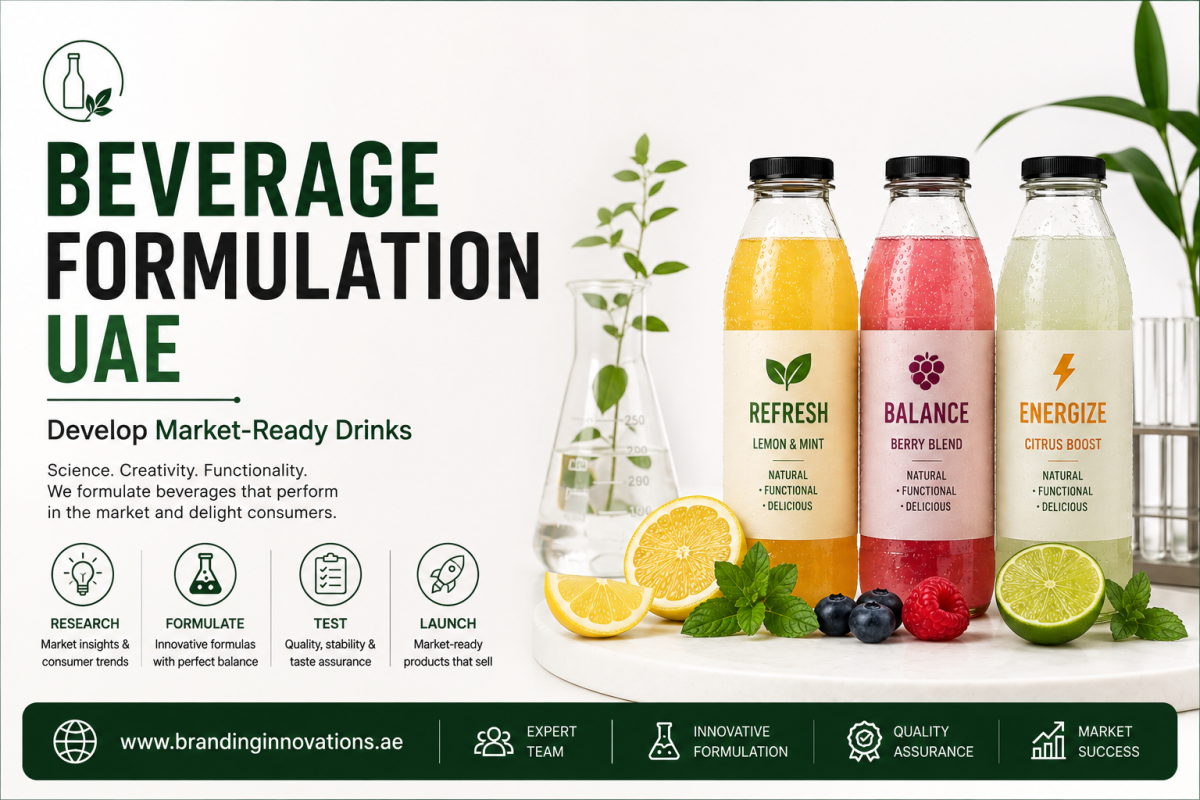
Developing a beverage in the UAE involves much more than creating a recipe that tastes good. A commercially successful drink needs the right combination of flavour, ingredients, stability, cost, nutritional profile, production requirements, packaging, and market positioning.
This is why beverage formulation in the UAE is such an important stage of product development. Whether you are planning a functional drink, wellness beverage, energy drink, flavoured water, juice, sports drink, or another ready-to-drink product, the formulation provides the technical foundation for turning an idea into a consistent commercial product.
With strong competition across the UAE food and beverage market, brands also need to think beyond the initial recipe. The product must deliver an appealing consumer experience while being practical to manufacture, package, distribute, and sell.
What Is Beverage Formulation?
Beverage formulation is the process of developing and balancing the ingredients that make up a beverage.
Depending on the product, formulation can involve:
- Ingredient selection
- Flavour development
- Sweetness and acidity
- pH management
- Colour and appearance
- Texture and mouthfeel
- Functional ingredients
- Nutritional composition
- Preservation
- Shelf stability
- Manufacturing requirements
- Packaging compatibility
The objective is not simply to produce a drink that tastes good during one trial. The formula should be capable of delivering a consistent result when the beverage is manufactured, stored, transported, and consumed.
A homemade recipe can therefore be a useful starting point, but it may require considerable development before it is ready for commercial production.
Why Is Beverage Formulation Important in the UAE?
The UAE has a diverse beverage market where consumers can choose from local products, international brands, premium beverages, functional drinks, juices, soft drinks, energy products, and wellness-focused options.
For a new brand, this creates both opportunity and competition.
A carefully developed formulation can help a business:
- Create a distinctive flavour profile
- Maintain consistent product quality
- Control ingredient costs
- Improve product stability
- Support commercial-scale manufacturing
- Develop an appropriate nutritional profile
- Build a clear market position
- Prepare for relevant regulatory requirements
For example, a company developing a low-sugar functional beverage may need to balance sweetness, flavour, mouthfeel, functional ingredients, stability, and production cost at the same time.
This is why formulation should be treated as part of the wider beverage development strategy rather than simply as recipe creation.
Key Steps in Beverage Formulation UAE
1. Define the Beverage Concept
Before selecting ingredients, it is important to establish what the beverage is supposed to achieve.
The development brief may define the target consumer, beverage category, flavour direction, intended benefits, packaging format, target price, and sales channels.
A drink designed for fitness consumers may require a different formulation approach from a premium beverage intended for hotels, cafés, or supermarkets.
A clear concept gives the development process direction and helps prevent unnecessary experimentation.
2. Select and Balance Ingredients
Ingredient selection is one of the most important parts of formulation.
Depending on the beverage, the formula may contain water, fruit ingredients, flavours, acids, sweeteners, vitamins, minerals, electrolytes, botanical ingredients, stabilisers, or preservatives.
However, ingredients cannot simply be selected individually. They need to work together.
One ingredient may affect flavour while another influences acidity, colour, solubility, texture, or stability. Some functional ingredients can also create bitterness or an undesirable aftertaste.
The goal is to achieve the right balance between functionality, taste, stability, and commercial practicality.
3. Develop the Flavour Profile
Taste strongly influences consumer acceptance and repeat purchases.
During beverage development, different combinations of sweetness, acidity, flavour intensity, aroma, and mouthfeel may be tested to create the desired sensory experience.
For UAE brands, flavour development can also consider local and regional preferences. Familiar ingredients or flavour profiles can be given a modern presentation to create a beverage that feels distinctive without becoming difficult for consumers to understand.
4. Manage Sugar and Sweeteners
Sugar and sweeteners have become particularly important considerations for beverage brands operating in the UAE.
From January 2026, the UAE introduced a tiered volumetric excise-tax model for sweetened drinks based on sugar and other sweetener content. Sweetened drinks containing 8 grams or more of total sugar and other sweeteners per 100 ml fall into the high-sugar category, while drinks containing 5 to less than 8 grams fall into the moderate category. Drinks below 5 grams per 100 ml have a zero rate under the model.
This makes formulation decisions relevant not only to taste and nutritional positioning but also to the commercial planning of a beverage.
Reducing sugar, however, is not as simple as removing it. Sugar contributes to sweetness, body, flavour balance, and mouthfeel. Replacing it may require careful reformulation to maintain a pleasant consumer experience.
5. Test Stability and Shelf Life
A commercial beverage needs to remain consistent throughout its intended shelf life.
Depending on the product, testing can consider:
- Microbiological stability
- pH
- Colour
- Flavour
- Separation
- Sedimentation
- Oxidation
- Ingredient degradation
- Packaging interaction
A beverage that performs well immediately after formulation may behave differently after storage or exposure to transportation conditions.
Shelf-life development therefore helps determine whether the formulation is suitable for the intended commercial environment.
From Kitchen Recipe to Commercial Formula
Many beverage businesses begin with an idea or recipe developed at home, in a restaurant kitchen, or through small-scale experimentation.
This is a useful starting point, but a successful small-batch recipe is not automatically a commercial formula.
Commercial manufacturing introduces different mixing systems, temperatures, processing conditions, filling equipment, storage environments, and production volumes.
For example, an ingredient may remain evenly distributed in a small sample but separate when the formula is produced at a much larger scale. Flavour and texture can also change depending on processing conditions.
This is why scale-up development is an important part of beverage formulation. The formula needs to be evaluated and adjusted so that it can be reproduced consistently at commercial volumes.
Beverage Formulation and UAE Compliance
Regulatory considerations should be addressed during product development rather than left until the final stage.
UAE food requirements can involve areas such as product information, labelling, food safety, ingredients, packaging, registration, and applicable claims. Local authorities also oversee food safety requirements and check aspects such as correct labels and expiry dates.
For sweetened beverages, the current excise framework also creates specific requirements around determining sugar and sweetener content. The Federal Tax Authority states that producers, importers, and stockpilers of sweetened drinks need the relevant conformity certification and registration procedures for the new model.
Therefore, formulation should be developed with the intended UAE market, product category, manufacturing process, and regulatory pathway in mind.
What Makes a Strong Beverage Formula?
A commercially useful beverage formula needs to balance several factors.
Taste
The product should provide an enjoyable flavour that encourages consumers to purchase it again.
Stability
The beverage should maintain its intended characteristics throughout its shelf life under appropriate storage conditions.
Cost
Ingredient choices need to support the target production cost and intended retail positioning.
Scalability
The formula should be suitable for consistent commercial manufacturing.
Compliance
The formulation, labelling, ingredients, packaging, and applicable claims should be developed with relevant requirements in mind.
Market Positioning
The formula should support the intended positioning, whether the product is premium, functional, natural, affordable, sports-focused, or wellness-oriented.
Common Beverage Formulation Mistakes
New beverage brands can encounter several problems when formulation is approached without sufficient planning.
Treating a homemade recipe as the final product: A kitchen recipe often needs technical adjustments before commercial production.
Choosing ingredients only because they are trending: A popular ingredient does not automatically create a successful beverage.
Ignoring manufacturing requirements: A formula must work with the intended production process.
Adding too many functional ingredients: Excessive ingredients can negatively affect taste, stability, texture, and cost.
Leaving compliance until the end: Regulatory considerations can influence formulation, labelling, claims, and product classification.
Focusing only on taste: Taste is essential, but commercial success also depends on stability, cost, packaging, positioning, and production.
Why Choose Branding Innovations for Beverage Formulation in the UAE?
Developing a beverage successfully requires several areas of expertise to work together. Branding Innovations takes an integrated approach to beverage development, helping businesses move from an initial concept toward a market-ready product.
End-to-End Beverage Development
Branding Innovations can support different stages of the beverage journey, including concept development, recipe and formulation, branding, packaging, production, launch, and buyer connections.
This integrated approach helps businesses consider the relationship between formulation and the other elements that influence commercial success.
UAE-Focused Product Development
A beverage intended for the UAE should be developed with its target consumers, competitive environment, category, positioning, and applicable requirements in mind.
This can help businesses make better decisions about flavour, format, packaging, and product positioning.
Commercial Scalability
The goal is not simply to create a successful prototype. The formula also needs to be practical for commercial production. Considering scale-up requirements during development can help reduce problems when moving from small trials to larger manufacturing batches.
Branding and Packaging Support
A good beverage formula needs to be supported by a strong market identity. Branding Innovations can help businesses develop branding and packaging that communicate the product’s proposition and create a consistent presentation.
Support Beyond Formulation
The development process does not necessarily end when the formula is completed. Branding Innovations also supports product launch and buyer connections, helping businesses move from beverage development toward commercial opportunities.
FAQs About Beverage Formulation in the UAE
How much does beverage formulation cost in the UAE?
The cost depends on the beverage category, formulation complexity, ingredients, number of prototypes, testing requirements, and production objectives. A simple drink generally requires a different development process from a technically complex functional beverage.
How long does beverage formulation take?
The timeline varies by product. Concept development, ingredient selection, prototyping, sensory testing, revisions, stability testing, and scale-up can all affect the overall development period.
Can a homemade recipe become a commercial beverage?
Yes. A homemade recipe can be used as a starting point, but it may need professional formulation and testing to improve stability, consistency, scalability, and manufacturing compatibility.
Is sugar reduction important for UAE beverage development?
It can be. The UAE’s current excise framework classifies sweetened beverages according to sugar and sweetener content, so formulation choices can have both product and commercial implications.
Can a UAE beverage be developed for GCC markets?
Yes. However, brands planning GCC expansion should consider the requirements of their intended markets for ingredients, labelling, packaging, registration, and claims during the development process.
What types of beverages can be formulated?
Depending on the product-development requirements, beverage formulation can cover functional drinks, wellness beverages, juices, flavoured water, sports drinks, energy beverages, botanical drinks, and other ready-to-drink concepts.
Conclusion
Beverage formulation in the UAE is the process of turning a beverage idea into a product that can deliver consistent taste, quality, stability, and commercial performance.
From ingredient selection and flavour development to shelf-life testing, scale-up, compliance, branding, and production planning, each stage can influence the final product.
For businesses planning to launch a beverage in the UAE, approaching formulation as part of a complete product-development strategy can provide a stronger foundation for manufacturing and market launch. With the right expertise, an initial recipe or concept can be developed into a commercially focused beverage designed for the demands of the UAE market.
About Richard Horwell
Richard Horwell has been behind more than 200 food and drink brands worldwide during the past 20 years, supporting projects from market research and recipe development through branding and production. His approach is built around innovation rather than imitation and honest guidance about the risks of launching a new brand. Next step: Discuss your beverage idea with the UAE team