
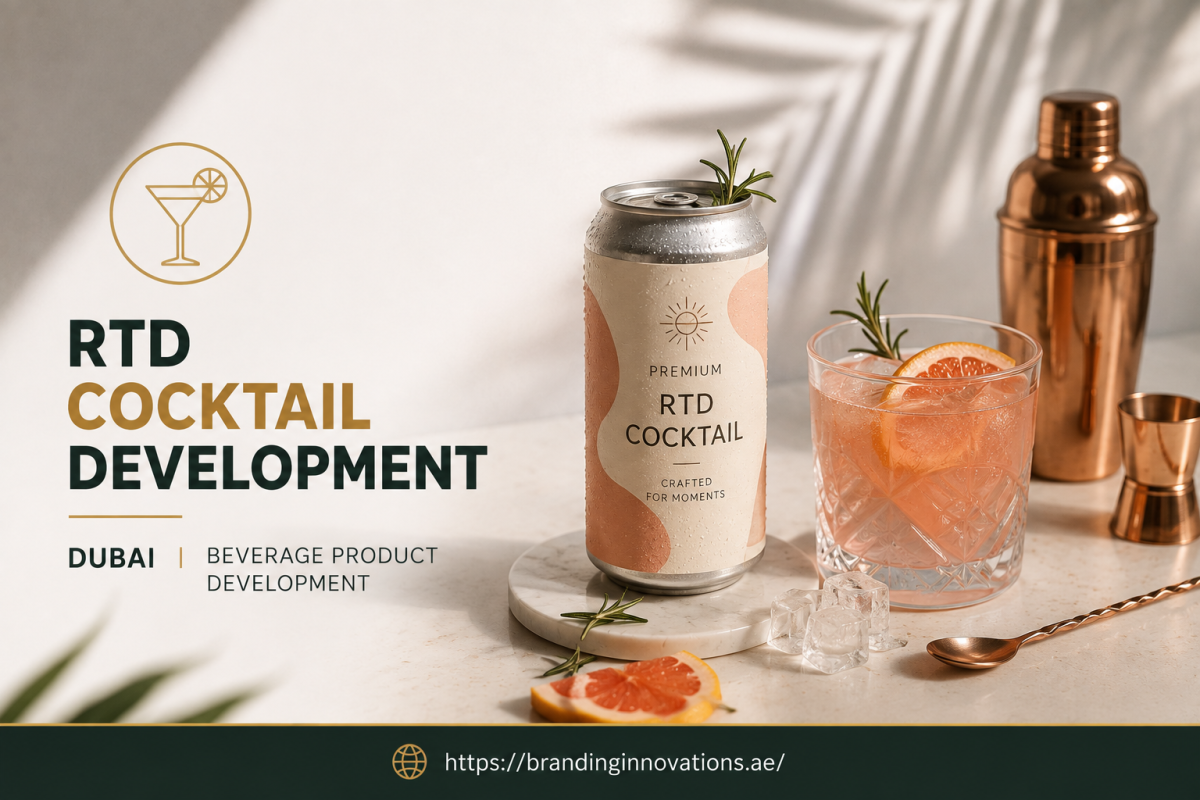
Ready-to-drink cocktails have become an increasingly interesting beverage format for businesses looking to offer convenient, consistent, and ready-to-serve cocktail experiences. Instead of requiring consumers or hospitality staff to mix several ingredients, an RTD cocktail provides a prepared beverage in a convenient package.
For businesses entering this category, RTD cocktail development in Dubai involves much more than creating a cocktail recipe. The product needs to deliver the intended flavour and drinking experience while also being suitable for commercial production, packaging, storage, distribution, and the intended market.
Dubai’s hospitality, tourism, retail, and entertainment sectors can create opportunities for innovative ready-to-drink beverage concepts. However, competition and regulatory requirements mean that businesses need a structured approach to product development.
Whether the concept is a classic cocktail, a modern flavour combination, a premium ready-to-serve drink, or a non-alcoholic cocktail-inspired beverage, professional development can help transform the initial idea into a commercially practical product.
What Is RTD Cocktail Development?
RTD stands for ready-to-drink. An RTD cocktail is a prepared beverage designed to be consumed directly from its packaging, usually without additional mixing.
Depending on the concept, an RTD cocktail can be developed around:
- Classic cocktail recipes
- Modern cocktail combinations
- Fruit-based flavours
- Citrus profiles
- Botanical ingredients
- Premium spirits
- Low-alcohol concepts
- Alcohol-free cocktail alternatives
- Sparkling cocktail formats
The development process can involve concept creation, ingredient selection, recipe formulation, flavour development, prototype testing, packaging, branding, manufacturing, and launch planning.
The goal is to reproduce a consistent and appealing cocktail experience in a convenient commercial format.
Why Is RTD Cocktail Development Important in Dubai?
Dubai is home to a diverse hospitality and retail environment, with hotels, restaurants, cafés, entertainment venues, supermarkets, and other channels offering opportunities for beverage brands.
Convenience is an important part of the RTD proposition.
A ready-to-drink cocktail can provide:
- Consistent flavour
- Convenient serving
- Easy storage
- Controlled portioning
- Faster preparation
- Portable consumption
- Consistent product quality
For hospitality businesses, an RTD format can also simplify service in appropriate settings by reducing the need to prepare every drink from multiple ingredients.
However, a successful product still needs a strong reason for consumers or businesses to choose it.
Key Stages of RTD Cocktail Development Dubai
1. Define the Cocktail Concept
The first step is establishing the product concept.
The development brief may identify:
- Target consumer
- Beverage style
- Alcohol content, where applicable
- Flavour profile
- Serving size
- Packaging format
- Price positioning
- Intended sales channels
- Brand personality
A premium cocktail intended for hotel and hospitality channels may require a different approach from a convenient retail product.
Similarly, an alcohol-free cocktail alternative may focus more heavily on botanical ingredients, fruit flavours, acidity, aroma, and mouthfeel.
A clearly defined concept provides direction for the entire development process.
2. Research the Market
Market research helps identify competitors and potential opportunities.
Research can examine:
- Existing RTD cocktail products
- Popular cocktail flavours
- Packaging formats
- Price points
- Consumer preferences
- Retail positioning
- Hospitality trends
- Emerging beverage concepts
The objective is not to duplicate existing products.
Instead, research should help identify gaps where a new beverage can offer something different.
For example, a brand might identify an opportunity for a premium citrus cocktail, a tropical RTD, a sophisticated botanical beverage, or an alcohol-free cocktail designed for consumers seeking an alternative to traditional alcoholic drinks.
3. Develop the RTD Cocktail Formula
Once the concept is established, the recipe needs to be adapted for commercial production.
A traditional cocktail recipe may work well when prepared immediately by a bartender but may not automatically perform well as an RTD product.
The formulation needs to consider:
- Ingredient compatibility
- Sweetness
- Acidity
- Alcohol level, where applicable
- Flavour intensity
- Aroma
- Mouthfeel
- Colour
- Stability
- Serving conditions
Some ingredients can behave differently when combined and stored over an extended period.
This makes professional formulation particularly important for RTD products.
4. Balance Flavour and Alcohol
For alcoholic RTD cocktails, flavour balance is closely connected to the alcohol content.
The beverage should deliver the intended cocktail character without allowing alcohol to overpower the other flavours.
Formulators may need to adjust:
- Sweetness
- Acidity
- Fruit flavours
- Botanical notes
- Alcohol level
- Aroma
- Mouthfeel
A strong cocktail formula should taste balanced from the first sip through the finish.
The target alcohol level also needs to be considered alongside the product’s intended positioning and applicable UAE requirements.
5. Develop the Flavour Profile
Flavour development is one of the most important stages of RTD cocktail development.
Possible directions can include:
- Citrus
- Berry
- Tropical fruit
- Peach
- Watermelon
- Mango
- Passion fruit
- Ginger
- Mint
- Botanical combinations
Classic cocktail profiles can also be adapted into convenient RTD formats.
However, flavour development should be based on the target consumer and brand positioning rather than simply selecting popular flavours.
A premium product may benefit from more complex flavour layering, while a mass-market RTD may require a familiar and immediately accessible taste.
6. Consider Carbonation and Mouthfeel
Carbonation can significantly change the drinking experience.
For sparkling RTD cocktails, the level of carbonation can influence:
- Refreshment
- Aroma release
- Mouthfeel
- Flavour perception
- Overall drinking experience
Too little carbonation can make the product feel flat, while excessive carbonation may overpower the flavour.
The formulation should therefore be tested under the conditions in which the final product is expected to be consumed.
Mouthfeel also needs attention because alcohol, acidity, sweeteners, fruit ingredients, and carbonation can all influence the texture and overall sensation of the drink.
7. Prototype Testing and Refinement
The first formulation should be treated as a starting point rather than the final product.
Several prototype versions may be developed to compare differences in:
- Flavour
- Sweetness
- Acidity
- Alcohol balance
- Carbonation
- Aroma
- Mouthfeel
- Aftertaste
Sensory testing can help determine which version delivers the strongest overall experience.
The formula can then be refined before commercial production.
This iterative approach helps reduce the risk of committing to a large manufacturing run before the product has been properly developed.
Shelf Life and Stability
An RTD cocktail needs to maintain its intended characteristics during storage and distribution.
The formulation may need to be assessed for potential changes in:
- Flavour
- Colour
- Aroma
- Carbonation
- Ingredient stability
- Appearance
Different ingredients can interact during storage, potentially changing the final product.
Packaging also plays an important role.
The chosen container needs to be appropriate for the beverage and its expected storage, transportation, and distribution conditions.
Shelf-life considerations should therefore be integrated into development rather than addressed only after the formula is finalised.
Commercial Manufacturing of RTD Cocktails
Moving from prototype development to commercial production is another major stage.
Commercial manufacturing can introduce differences in:
- Mixing
- Processing
- Ingredient distribution
- Filling
- Carbonation
- Packaging
- Production volume
A formula that works in a small development batch may require adjustments before being produced at scale.
Manufacturing economics also need to be considered.
Businesses should evaluate:
- Ingredient costs
- Packaging costs
- Minimum order quantities
- Filling costs
- Production volumes
- Storage
- Transportation
- Distribution
A successful RTD cocktail therefore needs to combine taste, consistency, scalability, and commercial viability.
Packaging and Branding for RTD Cocktails
Packaging is particularly important in the RTD category because the product often competes in visually crowded retail and hospitality environments.
Potential packaging formats can include:
- Cans
- Bottles
- Single-serve containers
- Premium glass formats
The right format depends on the intended market, product positioning, serving occasion, distribution channel, and manufacturing requirements.
Branding should communicate the product’s personality quickly.
Packaging development may include:
- Brand name
- Logo
- Typography
- Colour direction
- Flavour identification
- Product messaging
- Serving information
- Required regulatory information
A premium cocktail brand may require a sophisticated identity, while a younger or more casual product may use a more energetic visual direction.
UAE Regulatory Considerations
RTD cocktail development in Dubai requires careful consideration of applicable UAE requirements, particularly when the product contains alcohol.
Businesses developing alcoholic beverages need to consider the relevant licensing, production, importation, distribution, labelling, and sales requirements that apply to their specific business model and product.
Alcohol-containing beverages are also treated differently from sweetened drinks under the UAE’s current excise framework. The 2025 Cabinet Decision specifically excludes drinks containing alcohol from the sweetened-drink provisions, so businesses should not assume that the sweetened-beverage tax model applies to an alcoholic RTD cocktail.
For non-alcoholic or alcohol-free RTD cocktail products, different food and beverage requirements may apply. If the product contains added sugar or other sweeteners, its classification under the UAE’s current sweetened-drink framework should also be assessed.
Because requirements can depend on the exact formulation, alcohol content, packaging, and intended sales channel, businesses should obtain appropriate regulatory and licensing advice before commercial launch.
Why Choose Branding Innovations for RTD Cocktail Development?
Developing an RTD cocktail requires coordination between beverage formulation, flavour development, branding, packaging, manufacturing, and commercial launch.
Branding Innovations provides beverage development and branding support designed to connect these stages.
Beverage Development Expertise
An RTD product needs to deliver a consistent drinking experience while remaining practical for commercial manufacturing.
Branding Innovations works on beverage concepts, recipe development, flavour refinement, and product development.
Recipe and Flavour Development
The cocktail concept needs to be translated into a commercially suitable formula.
Recipe development can involve ingredient research, flavour development, sample creation, testing, and refinement to achieve the desired taste and product profile.
Branding and Packaging Support
A strong RTD cocktail also needs a distinctive identity.
Branding Innovations can connect beverage development with branding and packaging, helping create a product identity that reflects its intended positioning.
Manufacturing Connections
Once the formulation has been refined, commercial manufacturing becomes the next major step.
Branding Innovations works with an industry network of co-packers and suppliers, helping businesses move from development toward commercial production.
Launch and Buyer Connections
The development process does not end when the beverage is manufactured.
Branding Innovations also supports product launch and buyer connections, helping businesses consider potential commercial opportunities for their finished beverage.
Common RTD Cocktail Development Mistakes
Adapting a Bar Recipe Without Reformulation
A cocktail designed for immediate preparation may not remain stable or balanced when packaged for extended storage.
Focusing Only on Alcohol Content
Alcohol level is only one part of the product. Flavour, aroma, acidity, sweetness, carbonation, and mouthfeel all influence the consumer experience.
Ignoring Shelf Life
The product needs to remain consistent during storage and distribution.
Choosing Packaging Too Early
Packaging should support the product’s formulation, positioning, distribution requirements, and intended serving experience.
Underestimating Manufacturing
Commercial production can introduce technical challenges that do not appear during small-batch development.
Leaving Branding Until the End
The brand identity should be considered alongside the beverage concept rather than added after formulation is complete.
FAQs About RTD Cocktail Development in Dubai
What is an RTD cocktail?
An RTD cocktail is a ready-to-drink beverage designed to provide a prepared cocktail experience without requiring the consumer to mix multiple ingredients.
Can an existing cocktail recipe be developed into an RTD product?
Yes. An existing cocktail can be used as the starting point, but it may need reformulation to improve stability, flavour balance, shelf life, and suitability for commercial manufacturing.
Can RTD cocktails contain alcohol?
Yes. Alcoholic RTD cocktails can be developed, subject to the applicable UAE licensing, formulation, production, distribution, labelling, and sales requirements.
Can alcohol-free RTD cocktails be developed?
Yes. Alcohol-free cocktail-inspired beverages can be developed using combinations of fruit flavours, botanicals, acids, sweeteners, carbonation, and other suitable ingredients.
What flavours work well for RTD cocktails?
Citrus, tropical fruit, berry, peach, watermelon, passion fruit, ginger, mint, and botanical profiles can all be explored. The best flavour depends on the target consumer and brand positioning.
How long does RTD cocktail development take?
The timeline depends on the complexity of the recipe, flavour development, prototype rounds, stability requirements, packaging, manufacturing, and regulatory considerations.
Can an RTD cocktail be produced in cans?
Yes. Cans are one of the possible packaging formats for RTD beverages, although the appropriate packaging should be selected according to the specific formulation, processing method, product positioning, and distribution requirements.
Can an RTD cocktail developed in Dubai be sold across the GCC?
Potentially, but each target market may have different requirements relating to ingredients, alcohol, labelling, registration, taxation, importation, and distribution. These requirements should be assessed before regional expansion.
Conclusion
RTD cocktail development in Dubai requires much more than adapting a traditional cocktail recipe for a bottle or can. The product needs a carefully developed formula, balanced flavour, appropriate alcohol or alcohol-free positioning, reliable stability, suitable packaging, scalable manufacturing, and a strong brand identity.
For alcoholic products, businesses also need to consider the UAE’s specific licensing and regulatory environment. Alcohol-containing beverages are treated separately from the UAE’s sweetened-drink excise framework, making accurate product classification important during development.
For alcohol-free RTD cocktails, businesses can explore the growing range of fruit, botanical, sparkling, and functional beverage concepts while considering the applicable UAE food and beverage requirements.
By connecting concept development, recipe formulation, flavour refinement, testing, packaging, branding, manufacturing, and launch planning, businesses can build RTD cocktail products that are better prepared for commercial opportunities in Dubai and potentially across the wider GCC.
Branding Innovations provides an integrated beverage development approach, helping businesses move from an initial drink concept toward a refined product, distinctive brand, commercial production, and potential buyer opportunities.
About Richard Horwell
Richard Horwell has been behind more than 200 food and drink brands worldwide during the past 20 years, supporting projects from market research and recipe development through branding and production. His approach is built around innovation rather than imitation and honest guidance about the risks of launching a new brand. Next step: Discuss your beverage idea with the UAE team