
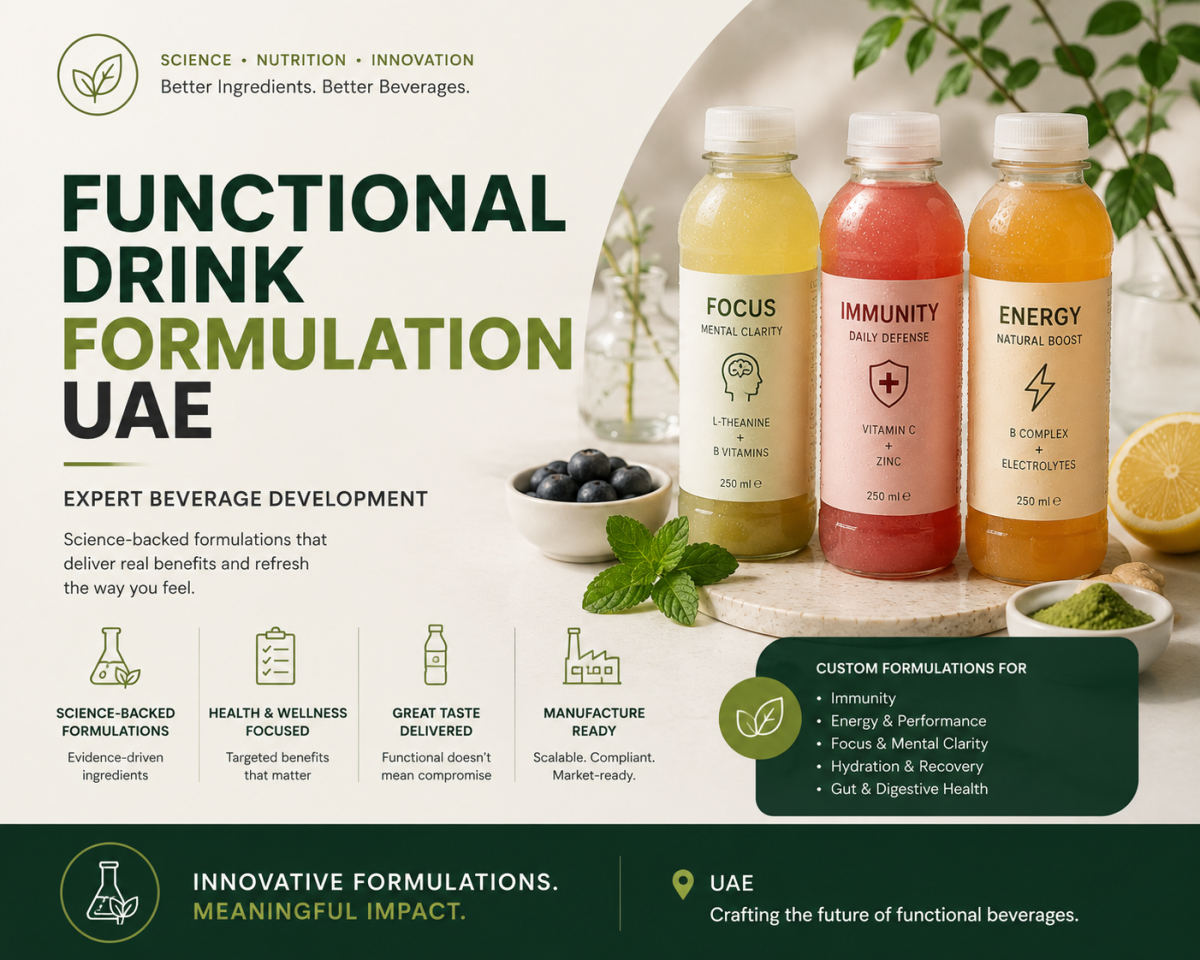
The demand for beverages that offer more than basic refreshment continues to create opportunities for innovative drink brands. Consumers are increasingly interested in products positioned around hydration, energy, wellness, focus, gut health, vitamins, minerals, and other functional benefits.
However, developing a functional drink requires more than adding a few popular ingredients to a beverage. The formula needs to balance functionality, taste, stability, ingredient compatibility, cost, and commercial production.
This makes functional drink formulation in the UAE an important part of developing a successful beverage brand.
Whether you are starting with a completely new concept, an existing recipe, or a specific functional ingredient, professional formulation can help transform the idea into a refined beverage that is better prepared for commercial manufacturing and market launch.
What Is Functional Drink Formulation?
Functional drink formulation is the process of creating and refining a beverage that contains ingredients selected for a specific nutritional, wellness, or functional purpose.
Depending on the product concept, functional drinks can focus on areas such as:
- Hydration
- Energy
- Focus
- Relaxation
- Gut health
- Vitamins and minerals
- Sports performance
- Recovery
- General wellness
Potential ingredients may include electrolytes, vitamins, minerals, botanicals, probiotics, prebiotics, adaptogens, nootropics, mushrooms, and other functional ingredients.
The important point is that the ingredients need to work within the complete beverage formula.
A functional ingredient may look attractive on paper but create bitterness, sedimentation, colour changes, or an unpleasant aftertaste. Professional formulation considers these challenges while working toward the desired product experience.
Why Is Functional Drink Formulation Important in the UAE?
The UAE has a competitive and diverse beverage market, with consumers exposed to local, regional, and international products.
This creates opportunities for functional beverage brands, but it also means that a new product needs a clear reason to exist.
A successful functional drink should answer questions such as:
- Who is the product for?
- What is its primary purpose?
- Which ingredients support that purpose?
- How does it taste?
- What makes it different?
- Can it be manufactured consistently?
- Can it be priced competitively?
Formulation connects many of these questions.
A strong functional beverage is not simply a drink containing multiple active ingredients. It is a carefully balanced product designed around a specific consumer and purpose.
Key Stages of Functional Drink Formulation UAE
1. Define the Functional Beverage Concept
Before selecting ingredients, the product concept needs to be clearly established.
The formulation brief may define:
- Target consumer
- Functional purpose
- Beverage category
- Preferred ingredients
- Flavour direction
- Sweetness level
- Nutritional objectives
- Packaging format
- Target price
- Intended sales channels
For example, a hydration beverage for athletes may focus on electrolytes and refreshing flavours, while a wellness drink for busy professionals may have a different functional proposition.
A focused concept helps prevent the formula from becoming overloaded with unnecessary ingredients.
2. Research and Select Functional Ingredients
Ingredient selection is one of the most important stages of functional drink formulation.
Different ingredients can provide different functional characteristics, but they can also affect the beverage’s sensory and technical properties.
Functional ingredients commonly explored in beverage development include:
Electrolytes
Electrolytes are commonly incorporated into beverages positioned around hydration and active lifestyles.
Vitamins and Minerals
These can be used in beverages designed around nutritional and wellness positioning.
Botanicals
Ingredients such as turmeric, moringa, and other plant-based ingredients can contribute to wellness-oriented product concepts.
Adaptogens
Adaptogens are increasingly explored in beverages positioned around stress management and general wellbeing.
Nootropics
These ingredients are often considered for products positioned around focus and cognitive performance.
Mushrooms
Functional mushrooms are increasingly appearing in wellness-oriented beverage concepts.
Prebiotics and Probiotics
These ingredients can be considered for beverages positioned around gut health.
Branding Innovations specifically highlights nootropics, herbal ingredients, mushrooms, pre- and probiotics, and adaptogens as areas of functional beverage innovation.
However, an ingredient should not be selected simply because it is trending. Its suitability for the beverage, target consumer, flavour profile, stability, regulatory requirements, and commercial objectives should also be considered.
3. Develop the Beverage Formula
Once the functional ingredients have been selected, they need to be incorporated into a complete beverage formula.
This is where technical and sensory challenges can arise.
Some functional ingredients can introduce:
- Bitterness
- Earthy flavours
- Strong aromas
- Sedimentation
- Cloudiness
- Texture changes
- Aftertaste
The formulation process may therefore involve adjusting ingredient levels, sweetness, acidity, flavours, and other components until the beverage reaches the desired profile.
The goal is to achieve a balance between:
Functionality + Taste + Stability + Cost
A functional drink needs to deliver its intended product proposition without sacrificing the consumer’s drinking experience.
4. Flavour Development and Refinement
Consumers may initially purchase a functional beverage because of its perceived benefits, but taste can strongly influence whether they buy it again.
This is why flavour development should be an important part of formulation.
Testing can assess:
- Aroma
- Sweetness
- Acidity
- Flavour intensity
- Mouthfeel
- Aftertaste
- Overall drinkability
Branding Innovations uses a research-led approach to flavour development, creating a detailed flavour brief before producing samples and refining the beverage until the desired flavour is achieved. Its recipe-development service also highlights the use of functional ingredients to create distinctive product propositions.
This is particularly useful when functional ingredients create challenging sensory characteristics.
5. Prototype Development
The first formula is usually not the final formula.
Prototype development allows different versions of the beverage to be created and compared.
For example, developers may test:
- Different functional ingredient levels
- Different sweeteners
- Multiple flavour combinations
- Different acidity levels
- Alternative ingredient combinations
Feedback can then be used to refine the product.
Repeated development can help move the beverage from an initial concept toward a more polished commercial formula.
Functional Drink Stability and Shelf Life
A functional beverage also needs to remain consistent during storage.
Ingredient interactions can affect:
- Colour
- Flavour
- Texture
- Solubility
- Sedimentation
- Appearance
This makes stability an important consideration during formulation.
The objective is not simply to create a beverage that tastes good immediately after production. The formula should also be developed with its intended storage and commercial life in mind.
This is particularly important when working with botanical, mineral, vitamin, probiotic, or other functional ingredients.
Commercial Scale-Up and Manufacturing
A successful laboratory or development sample does not automatically mean that the beverage is ready for mass production.
Commercial manufacturing introduces different:
- Production volumes
- Mixing equipment
- Processing conditions
- Filling systems
- Temperatures
- Storage environments
A formula may behave differently when produced on a much larger scale.
For example, an ingredient that remains evenly distributed in a small sample may separate during commercial production.
Manufacturing costs also need to be considered. Some functional ingredients are expensive, and excessive ingredient costs can make the final product difficult to price competitively.
A commercially viable formula should therefore be developed with manufacturing in mind from the beginning.
UAE Considerations for Functional Drink Formulation
Functional drinks intended for the UAE market need to be developed with applicable requirements relating to ingredients, labelling, product registration, packaging, and product claims in mind.
This is especially important for functional beverages because the way a product is marketed can depend on the ingredients it contains and the claims made about them.
Businesses should obtain appropriate regulatory and technical guidance for their individual product before launch.
Sugar and Sweetener Considerations
Sugar content can also influence the commercial position of a beverage in the UAE.
Since 1 January 2026, the UAE has used a tiered volumetric excise-tax model for sweetened drinks. The Federal Tax Authority classifies sweetened beverages according to total sugar and other sweetener content per 100 ml. Under the current model, drinks containing less than 5 g per 100 ml fall into the low-sugar category with an excise rate of AED 0, while higher categories are subject to higher per-litre rates.
Energy drinks remain subject to a separate 100% excise-tax treatment rather than the tiered volumetric model.
For functional beverage brands, these considerations make formulation decisions relevant not only to taste and product positioning but also to commercial planning.
Why Choose Branding Innovations for Functional Drink Formulation UAE?
Selecting the right formulation and development partner can help businesses move more efficiently from an initial idea to a market-ready beverage.
Branding Innovations specialises in beverage development and branding and states that it has developed and launched more than 200 food and drink brands worldwide over the last 20 years. The company specifically highlights expertise in FMCG, food and beverage innovation, and functional wellness ingredients.
Functional Ingredient Expertise
Functional beverages require careful ingredient selection because active ingredients can influence taste, texture, stability, and the overall product proposition.
Branding Innovations’ recipe-development service specifically highlights experience with nootropics, herbal ingredients, mushrooms, pre- and probiotics, and adaptogens.
Experienced Recipe Development
Branding Innovations’ recipe developer brings more than 38 years of industry experience. The development process includes creating samples and continuing to refine the product until the desired flavour is achieved.
This experience can be particularly valuable when developing functional beverages with challenging flavour profiles.
End-to-End Beverage Development
Formulation is only one part of building a successful drink brand.
Branding Innovations supports businesses across research, recipe development, branding, packaging, manufacturing, product launch, and buyer connections.
This allows businesses to consider the commercial product as a whole rather than developing the formula in isolation.
Branding and Packaging Support
A strong functional beverage also needs a clear market identity.
Branding Innovations combines product development with branding and packaging, helping businesses communicate the beverage’s purpose and positioning through its visual identity.
Manufacturing Connections
After formulation, the beverage needs to move into commercial production.
Branding Innovations highlights its industry network of co-packers and suppliers as part of its end-to-end development process.
Buyer Connections
Product development should ultimately connect with market opportunities.
Branding Innovations states that it has a proprietary database of more than 6,500 buyers, including retailers, wholesalers, and distributors.
This provides an additional commercial connection for businesses preparing to launch their functional beverage.
Common Functional Drink Formulation Mistakes
Adding Too Many Functional Ingredients
A long ingredient list does not necessarily make a better beverage. A focused formula can create a clearer proposition.
Ignoring Taste
Consumers may be attracted by functionality, but an unpleasant taste can discourage repeat purchases.
Selecting Ingredients Only Because They Are Trending
Trending ingredients still need to be suitable for the product concept, target audience, formula, and intended market.
Ignoring Manufacturing Costs
High-cost functional ingredients can make a product commercially difficult if they are not carefully managed.
Leaving Regulatory Considerations Until the End
Ingredients, product claims, labelling, registration, and applicable tax considerations should be reviewed during development.
FAQs About Functional Drink Formulation in the UAE
What is functional drink formulation?
Functional drink formulation is the process of developing a beverage containing ingredients selected for a specific nutritional, wellness, or functional purpose while balancing taste, stability, and commercial requirements.
What ingredients can be used in functional drinks?
Depending on the concept, functional drinks may include electrolytes, vitamins, minerals, botanicals, probiotics, prebiotics, adaptogens, mushrooms, nootropics, and other suitable functional ingredients.
Can you formulate a drink from my existing recipe?
Yes. An existing recipe can be used as a starting point and refined to improve flavour, functionality, consistency, stability, and suitability for commercial manufacturing.
How long does functional drink formulation take?
The timeline varies depending on the beverage’s complexity, ingredient selection, number of prototypes, testing requirements, stability considerations, and manufacturing objectives.
Can functional drinks be formulated with low sugar?
Yes. Low-sugar functional drinks can be developed by carefully balancing sweetness, acidity, flavour, mouthfeel, and functional ingredients. The UAE’s current sweetened-drink classification should also be considered during formulation.
Can functional drinks developed in the UAE be sold in the GCC?
Potentially, yes. However, each target GCC market may have its own requirements for ingredients, labelling, registration, claims, and other regulatory matters, so the product should be reviewed for each intended market.
Conclusion
Functional drink formulation in the UAE requires a careful balance between innovative ingredients, enjoyable taste, technical stability, commercial scalability, and market requirements.
The strongest functional beverages are not simply products containing a long list of wellness ingredients. They are carefully formulated drinks with a clear purpose, appealing flavour, consistent quality, and a proposition that makes sense for the target consumer.
From ingredient research and recipe formulation to prototype development, flavour refinement, stability, manufacturing, branding, and launch, every stage can influence the final product.
For businesses looking to develop a functional beverage in the UAE, Branding Innovations offers an integrated approach that connects functional ingredient expertise and recipe development with branding, packaging, manufacturing, product launch, and buyer connections—helping transform a functional drink concept into a commercially focused beverage brand.
About Richard Horwell
Richard Horwell has been behind more than 200 food and drink brands worldwide during the past 20 years, supporting projects from market research and recipe development through branding and production. His approach is built around innovation rather than imitation and honest guidance about the risks of launching a new brand. Next step: Discuss your beverage idea with the UAE team