
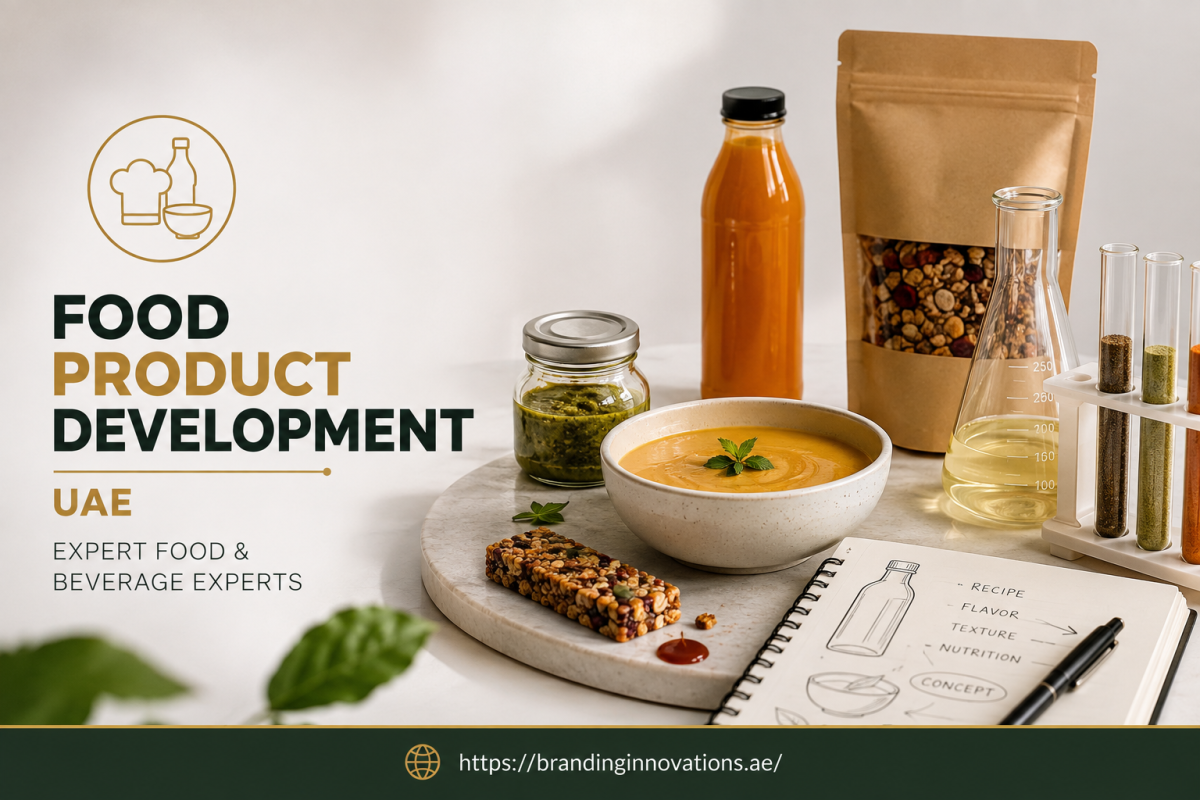
The UAE has developed into a major regional market for food, beverage, retail, hospitality, and consumer products. With a diverse population and strong demand for innovative food concepts, businesses have opportunities to introduce everything from healthier snacks and functional foods to sauces, confectionery, ready meals, and premium packaged products.
However, taking a food idea from concept to supermarket shelf requires much more than creating a recipe.
A successful product needs the right ingredients, taste, texture, nutritional profile, packaging, shelf life, manufacturing process, brand positioning, and commercial strategy. It must also meet the relevant food safety and labelling requirements before entering the market.
This makes food product development in the UAE a structured process that combines product innovation with technical and commercial planning.
Whether you are starting with an original food concept, improving an existing recipe, developing a private-label product, or creating a completely new consumer brand, professional product development can help turn the idea into a commercially viable product.
What Is Food Product Development?
Food product development is the process of transforming a food idea into a finished product suitable for commercial production and sale.
The process can involve:
- Market research
- Product concept development
- Ingredient selection
- Recipe development
- Texture and flavour optimisation
- Prototype testing
- Shelf-life considerations
- Nutritional evaluation
- Packaging development
- Branding
- Manufacturing
- Product launch
Different food categories require different development approaches.
These can include:
- Snacks
- Sauces and condiments
- Bakery products
- Confectionery
- Functional foods
- Nutritional products
- Ready-to-eat foods
- Frozen foods
- Plant-based products
- Breakfast products
- Food mixes
- Private-label products
The objective is to create a product that consumers want while making sure it can also be produced consistently and economically.
Why Is Food Product Development Important in the UAE?
The UAE food market includes international brands, regional manufacturers, private-label products, restaurants, hospitality businesses, and emerging food brands.
This creates significant competition.
A new food product therefore needs a clear proposition.
Businesses need to understand:
- Who the product is for
- What consumer need it addresses
- What makes it different
- What ingredients it uses
- How it tastes
- What price it can achieve
- Where it will be sold
- How it will be manufactured
Professional food product development helps businesses evaluate these factors before investing heavily in production, packaging, and marketing.
Dubai’s food-security strategy also places emphasis on food safety and quality, local production, diversified food sources, and reducing food waste, reinforcing the importance of a well-planned food product journey.
Key Stages of Food Product Development UAE
1. Market Research and Product Opportunity
The first step is understanding the market.
Research can examine:
- Existing competitors
- Consumer preferences
- Product trends
- Popular ingredients
- Flavour preferences
- Packaging formats
- Retail prices
- Distribution channels
- Market gaps
The objective is not to copy existing products.
Instead, research should identify where a new food product can provide something different.
For example, there may be an opportunity for a premium snack, healthier confectionery, plant-based product, functional food, innovative sauce, or convenient ready-to-eat meal.
A strong product begins with a clear reason for existing.
2. Food Concept Development
Once the opportunity has been identified, the concept needs to be defined.
The product brief may include:
- Product category
- Target consumer
- Main benefit or proposition
- Ingredient direction
- Flavour
- Texture
- Portion size
- Packaging
- Price positioning
- Intended sales channels
For example, a premium health-focused snack may require a very different formulation and packaging strategy from an affordable family food product.
Defining the concept early helps ensure that formulation, branding, and manufacturing decisions remain aligned.
3. Ingredient Selection
Ingredients form the foundation of any food product.
The selection process needs to consider more than taste.
Ingredients can influence:
- Flavour
- Texture
- Appearance
- Nutrition
- Shelf life
- Manufacturing
- Cost
- Consumer perception
Businesses may also want to explore particular ingredient directions, such as natural ingredients, plant-based ingredients, functional components, reduced-sugar systems, high-protein ingredients, or clean-label positioning.
However, ingredient choices should be based on the complete product concept rather than simply following a popular trend.
Every ingredient needs to work within the formula and the intended manufacturing process.
4. Recipe Development and Formulation
The recipe is where the product concept becomes a practical food product.
Food formulation may involve adjusting:
- Ingredient ratios
- Flavour
- Sweetness
- Acidity
- Texture
- Moisture
- Fat content
- Protein content
- Seasoning
- Appearance
The goal is to achieve a product that delivers a consistent experience from one batch to another.
A recipe that tastes good in a small kitchen batch may not automatically work during commercial production.
This is why professional formulation should consider both sensory quality and manufacturing requirements.
Branding Innovations positions recipe development as a core part of its product-development process, combining research, ingredient selection, recipe creation, and refinement before moving toward branding and production.
5. Flavour and Texture Development
Taste is one of the strongest factors influencing food purchases and repeat consumption.
Flavour development can involve testing:
- Sweetness
- Saltiness
- Acidity
- Spice levels
- Aroma
- Seasoning
- Aftertaste
Texture is equally important for many food categories.
Depending on the product, developers may need to evaluate:
- Crunchiness
- Creaminess
- Softness
- Crispness
- Chewiness
- Thickness
- Mouthfeel
A product can have excellent ingredients and still struggle commercially if the flavour or texture does not meet consumer expectations.
This makes sensory refinement an important stage of food product development.
6. Prototype Development and Testing
The first version of a food product is usually a starting point rather than the final formula.
Several prototypes may be created to compare different ingredient combinations and processing methods.
Testing can evaluate:
- Taste
- Texture
- Appearance
- Aroma
- Portion size
- Ingredient balance
- Overall consumer experience
The formula can then be refined based on the results.
This iterative approach helps businesses identify problems before committing to large-scale production.
Shelf Life and Stability
A commercially produced food product needs to remain safe and maintain its intended quality throughout its shelf life.
Development may therefore need to consider:
- Moisture
- Oxidation
- Microbial stability
- Texture changes
- Flavour changes
- Colour
- Packaging protection
- Storage conditions
Different food products require different shelf-life strategies.
For example, a dry snack may have very different stability requirements from a refrigerated ready meal or a sauce.
Packaging also plays an important role in protecting the product during storage and transportation.
Shelf-life considerations should therefore be integrated into product development rather than left until the final stage.
Commercial Scale-Up and Manufacturing
One of the biggest challenges in food product development is moving from a small prototype to commercial production.
Commercial manufacturing introduces different:
- Equipment
- Processing conditions
- Production volumes
- Mixing systems
- Filling processes
- Cooking methods
- Packaging systems
A recipe that works in a development kitchen may need adjustment before it can be produced efficiently at scale.
Manufacturing economics also need to be evaluated.
Important considerations include:
- Ingredient costs
- Packaging costs
- Production volumes
- Minimum order quantities
- Labour
- Processing
- Storage
- Transportation
A successful food product therefore needs to balance quality, consumer appeal, consistency, and commercial viability.
Packaging and Branding for Food Products
Packaging is often the first point of contact between a food product and a consumer.
In a competitive retail environment, packaging needs to communicate the product quickly.
Food packaging can include:
- Brand identity
- Logo
- Product name
- Flavour
- Product positioning
- Key messaging
- Serving information
- Required product information
The visual identity should match the intended market.
A premium food product may require a sophisticated design, while a family-oriented snack may benefit from a more approachable visual identity.
Branding should also work together with the product itself.
The promise made on the package needs to accurately reflect the actual food experience.
UAE Food Safety and Registration Considerations
Food product development in the UAE needs to account for applicable food safety, labelling, registration, and import or manufacturing requirements.
The UAE’s official food-safety guidance states that Federal Law No. 10 of 2015 establishes requirements for food safety and quality, while local authorities oversee food-safety requirements in individual emirates. In Dubai, food safety falls under the relevant municipal authority.
The UAE also has a National Food Accreditation and Registration System. Official guidance states that food products imported into the UAE, locally produced products, and products whose labels, ingredients, or composition have been modified are subject to registration requirements before being handled in UAE markets.
This makes regulatory planning an important part of product development.
Ingredient choices, product claims, labels, nutritional information, packaging, and intended market should all be reviewed before commercial launch.
Businesses should obtain appropriate regulatory advice for their specific product because requirements can vary according to the food category and intended use.
Why Choose Branding Innovations for Food Product Development?
Food product development involves many connected stages. Choosing a partner that can support several of these stages can make the process more organised and commercially focused.
Branding Innovations specialises in food and beverage innovation and branding, with the company stating that it has developed and launched more than 200 food and drink brands worldwide over the past 20 years.
End-to-End Product Development
Branding Innovations supports the development journey from research and recipe creation through branding, packaging, manufacturing, and product launch.
This allows different parts of the product strategy to be considered together rather than developed in isolation.
Recipe Development and Refinement
A strong food product starts with the right recipe.
Branding Innovations focuses on ingredient research, recipe development, and refinement, helping businesses move from an initial idea toward a more developed product.
Branding and Packaging
A food product also needs a clear identity.
Branding Innovations combines product development with branding and packaging support, helping businesses create packaging that reflects the product’s positioning and target market.
Manufacturing Connections
Once a recipe has been developed, commercial production becomes the next important step.
Branding Innovations states that it has a broad industry network for identifying co-packers and suppliers and helping businesses move toward commercial manufacturing.
Buyer Connections
Product development ultimately needs to connect with commercial opportunities.
Branding Innovations states that it has access to more than 6,500 buyers across retailers, wholesalers, and distributors.
This creates a potential pathway from product development and manufacturing toward retail and distribution opportunities.
Common Food Product Development Mistakes
Starting Without Market Research
A product may taste good but still struggle if there is no clear consumer demand or differentiation.
Focusing Only on Ingredients
Ingredient quality matters, but flavour, texture, packaging, pricing, manufacturing, and positioning also influence success.
Ignoring Commercial Scale
A recipe needs to work consistently when produced at commercial volumes.
Developing Packaging Too Late
Packaging should be considered alongside the product concept because it can influence positioning, cost, shelf life, and consumer perception.
Making Unverified Product Claims
Food claims need to be carefully assessed against applicable requirements. Misleading food descriptions or incorrect labels can result in penalties under UAE food-safety law.
Ignoring Production Costs
A product can be technically excellent but commercially difficult if ingredient, packaging, manufacturing, and logistics costs are too high.
FAQs About Food Product Development in the UAE
What is food product development?
Food product development is the process of turning a food idea into a commercially viable product through research, formulation, testing, packaging, manufacturing, and launch planning.
What types of food products can be developed?
Development can cover snacks, sauces, confectionery, ready meals, functional foods, nutritional products, bakery products, plant-based foods, food mixes, and many other packaged food categories.
Can I develop a food product from my own recipe?
Yes. An existing recipe can be used as a starting point and refined to improve flavour, texture, consistency, shelf life, manufacturing suitability, and commercial viability.
Can a completely new food product be created?
Yes. A product can be developed from an initial idea through market research, concept development, ingredient selection, formulation, prototyping, testing, packaging, and commercial manufacturing.
How long does food product development take?
The timeline depends on the product category, formulation complexity, number of prototype rounds, shelf-life requirements, packaging, manufacturing, and regulatory considerations.
Does food product development include packaging?
It can. Packaging is an important part of commercial product development because it can influence shelf life, product protection, consumer perception, cost, and distribution.
Does a food product need to be registered in the UAE?
Applicable food products may need to be registered before being handled in UAE markets. Official UAE guidance states that imported, locally produced, or modified food products fall within the national food registration framework.
Can a UAE food product be expanded into the GCC?
Potentially, yes. However, each GCC market can have different requirements for ingredients, labelling, product registration, claims, taxation, importation, and distribution. These requirements should be assessed before entering each market.
Conclusion
Food product development in the UAE is a multi-stage process that combines food innovation, formulation, sensory development, manufacturing, branding, packaging, and commercial planning.
A successful food product needs more than an interesting idea. It requires a well-developed recipe, appealing flavour and texture, reliable shelf life, suitable packaging, scalable manufacturing, clear positioning, and compliance with applicable UAE requirements.
By connecting market research, concept development, ingredient selection, recipe formulation, prototype testing, packaging, branding, manufacturing, and product launch, businesses can create food products that are better prepared for the competitive UAE market.
Branding Innovations provides an integrated approach to food and beverage product development, helping businesses move from an initial concept toward a refined product, distinctive brand, commercial production, and potential buyer opportunities.
About Richard Horwell
Richard Horwell has been behind more than 200 food and drink brands worldwide during the past 20 years, supporting projects from market research and recipe development through branding and production. His approach is built around innovation rather than imitation and honest guidance about the risks of launching a new brand. Next step: Discuss your beverage idea with the UAE team