
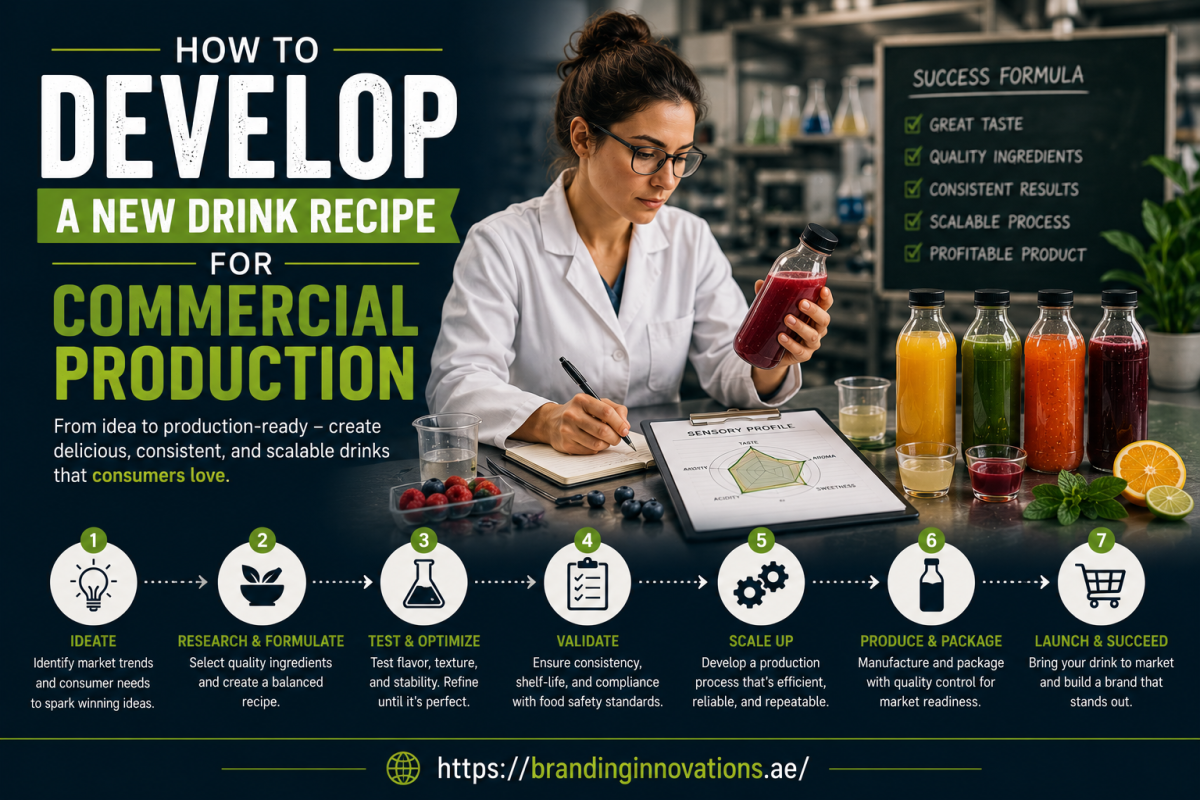
Developing a drink recipe for your own kitchen is very different from creating a formula that can be produced consistently at commercial scale. A recipe that tastes excellent in a small batch may change when ingredients, equipment, processing methods, packaging, and production volumes are increased.
Learning how to develop a new drink recipe for commercial production therefore requires a structured approach. You need to understand the target market, select suitable ingredients, create and refine the formulation, test stability and quality, consider packaging, and prepare the recipe for manufacturing.
For entrepreneurs entering the UAE beverage market, product development also needs to account for applicable requirements, consumer preferences, production capabilities, and commercial positioning. Professional beverage development support can help bridge the gap between a creative drink idea and a market-ready product.
Start With a Clear Beverage Concept
Before developing ingredients or quantities, define what you want the finished beverage to achieve.
Identify Your Target Customer
Your target customer should influence the recipe from the beginning. Consider who will drink the product, when they will consume it, and what they expect from it.
Your audience could include:
- Fitness enthusiasts
- Busy professionals
- Students
- Families
- Wellness-focused consumers
- Travelers
- Children or young adults
If you are planning to sell in the UAE, research local preferences rather than relying entirely on assumptions from another market. Flavor preferences, consumption occasions, price expectations, and preferred formats can vary between audiences.
Define the Product’s Purpose
Decide whether your drink is intended primarily for refreshment, hydration, energy, wellness, nutrition, or another specific purpose.
A clear purpose helps guide decisions about ingredients, flavor, packaging, pricing, and marketing.
For example, a hydration beverage may require a different formulation strategy from a premium fruit drink or functional wellness product.
Research the Market Before Formulating
Developing a recipe without understanding the market can result in a technically good product that has limited commercial potential.
Study Competitors
Research beverages already competing in your intended category.
Compare:
- Ingredients
- Flavors
- Packaging
- Serving sizes
- Pricing
- Functional positioning
- Brand messaging
Look at customer reviews as well. They can reveal what consumers like and dislike about competing beverages.
Identify an Opportunity
Your research should help you identify a reason for your beverage to exist.
You might discover an opportunity around:
- A distinctive flavor
- A different ingredient combination
- A convenient format
- A specific consumer group
- Lower sugar
- Functional positioning
- Premium ingredients
- A particular price segment
Your recipe should support this market opportunity rather than simply reproduce what is already available.
Select the Right Ingredients
Ingredient selection is at the heart of commercial beverage formulation. Every ingredient should have a clear purpose and be suitable for the intended product.
Evaluate Ingredient Function
Depending on your beverage, ingredients may contribute to flavor, sweetness, acidity, color, texture, preservation, nutrition, or functionality.
Consider:
- Ingredient quality
- Availability
- Cost
- Solubility
- Compatibility
- Stability
- Processing requirements
- Applicable regulations
An ingredient that performs well in a homemade recipe may behave differently during commercial processing.
Consider Ingredient Sourcing
Before finalizing a recipe, determine whether your ingredients can be sourced consistently in the quantities required for production.
A recipe that depends on an ingredient with limited availability or unpredictable pricing may become difficult to manufacture profitably.
For UAE-based beverage businesses, working with experienced beverage formulation services in the UAE can help evaluate ingredient selection alongside commercial production requirements.
Create the Initial Commercial Formula
Once the concept and ingredients are established, you can begin developing the formula.
Convert the Recipe Into Precise Measurements
Commercial production requires precision. Instead of relying on approximate measurements such as “a little more” or “to taste,” establish exact quantities and ratios for every ingredient.
Your formulation should document:
- Ingredient names
- Exact quantities
- Percentages
- Processing sequence
- Target pH where relevant
- Target sweetness
- Batch size
- Mixing requirements
- Processing conditions
This creates a reproducible formula that can be tested and eventually transferred to a manufacturing environment.
Balance Flavor and Functionality
A commercial beverage should deliver a consistent sensory experience.
Depending on the product, formulation may require adjustments to:
- Sweetness
- Acidity
- Flavor intensity
- Aroma
- Mouthfeel
- Color
- Aftertaste
If the beverage contains functional ingredients, balancing those components with flavor becomes especially important because some active ingredients can introduce bitterness or unusual sensory characteristics.
Test and Refine the Recipe
The first formula should be treated as a starting point rather than a finished product.
Conduct Sensory Testing
Taste testing can help identify whether the beverage meets your intended product profile.
Evaluate:
- Flavor
- Aroma
- Sweetness
- Acidity
- Texture
- Appearance
- Aftertaste
- Overall acceptance
Testing with people who match your target audience can provide more useful feedback than relying solely on the development team’s preferences.
Make Controlled Adjustments
When a problem is identified, change one or a small number of variables at a time.
This makes it easier to determine which adjustment improved or worsened the product.
Multiple development rounds may be necessary before the formulation reaches the desired balance between taste, functionality, cost, and stability.
Test the Beverage for Stability
A beverage that tastes good immediately after preparation may not remain the same over weeks or months.
Evaluate Shelf-Life Performance
Shelf-life testing helps determine whether the beverage maintains appropriate quality throughout its intended storage period.
Depending on the product, factors that may require evaluation include:
- Temperature
- Light
- Oxygen
- Acidity
- Ingredient interactions
- Microbiological stability
- Packaging
- Processing conditions
The appropriate testing program depends on the product and target market.
Check Ingredient Compatibility
Ingredients can interact with one another over time. Some may settle, separate, change color, lose potency, or affect flavor.
Commercial formulation should therefore evaluate how the complete formula behaves rather than testing ingredients only individually.
Make the Recipe Suitable for Commercial Production
Scaling a recipe is one of the most important steps in beverage product development.
Move From Small Batch to Pilot Production
A kitchen or laboratory batch does not perfectly represent commercial manufacturing conditions.
Pilot production can help identify issues involving:
- Mixing
- Heating
- Cooling
- Filtration
- Filling
- Carbonation
- Ingredient dispersion
- Processing time
Pilot testing provides an opportunity to solve these problems before committing to a large production run.
Evaluate Manufacturing Compatibility
The formula should work with the equipment and processes used by your chosen manufacturer.
Some ingredients may require specialized handling, while certain beverages may require specific processing or filling methods.
Discuss your formulation with the manufacturer early rather than waiting until the final production stage.
Choose Packaging for the Beverage
Packaging is part of the product-development process, not simply a marketing decision.
Select the Right Container
Depending on the beverage, options may include:
- Cans
- PET bottles
- Glass bottles
- Cartons
- Pouches
- Sachets
The choice should consider product compatibility, shelf life, cost, transportation, storage, customer expectations, and manufacturing capabilities.
Consider Packaging and Formula Together
Some beverages may be sensitive to light or oxygen, making certain packaging materials more appropriate than others.
Professional beverage packaging services in the UAE can help connect packaging design and technical requirements with the overall brand strategy.
Review UAE Regulatory Requirements
If you intend to commercialize your drink in the UAE, regulatory considerations should be addressed during formulation rather than after the recipe has been finalized.
Review Ingredients and Product Claims
Ingredients, nutritional information, allergens, labeling, and marketing claims may be subject to applicable requirements.
Claims relating to health, nutrition, energy, wellness, or functionality should be reviewed carefully before being included on packaging or promotional materials.
Prepare for Commercial Launch
A formulation that is technically successful still needs to meet the applicable requirements of its target market.
Working with professionals experienced in beverage product development in the UAE can help entrepreneurs consider formulation, packaging, manufacturing, and compliance as connected parts of the development process.
Calculate the Commercial Cost
A great recipe must also make financial sense.
Calculate Cost Per Unit
Estimate the cost of each ingredient at commercial purchasing volumes, then add relevant manufacturing and packaging costs.
Your calculation may include:
- Ingredients
- Processing
- Manufacturing
- Packaging
- Testing
- Storage
- Transportation
This gives you an estimated production cost per unit.
Optimize Without Sacrificing Quality
If the cost is too high, look for opportunities to improve efficiency without damaging the product.
Possible approaches include:
- Reviewing ingredient quantities
- Comparing suppliers
- Selecting alternative packaging
- Optimizing batch size
- Reducing unnecessary formulation complexity
Cost optimization should never compromise essential product quality, safety, or consumer experience.
Why Choose Branding Innovations UAE?
Developing a drink recipe for commercial production requires more than technical formulation. The final product also needs appropriate branding, packaging, manufacturing coordination, and a clear route to market.
Branding Innovations UAE provides beverage development services in the UAE, helping entrepreneurs move from an initial beverage concept toward a commercially prepared product.
Its support can bring together recipe development, beverage formulation, branding, packaging, production coordination, and commercialization. This integrated approach can be useful for businesses that want to avoid managing each stage independently.
For entrepreneurs targeting Dubai, Abu Dhabi, or the wider UAE market, working with a beverage development partner familiar with the local commercial environment can help connect the technical requirements of a recipe with the practical requirements of launching a brand.
Frequently Asked Questions
Can I Turn a Homemade Drink Recipe Into a Commercial Product?
Yes, but a homemade recipe usually needs to be reformulated and tested for commercial production. Ingredient quantities, processing methods, shelf life, stability, packaging, and manufacturing requirements all need to be evaluated.
How Do I Make a Beverage Recipe Scalable?
Start with precise ingredient measurements and documented processing instructions. Then test the formula through pilot production to identify differences between small-batch preparation and commercial manufacturing.
How Long Does It Take to Develop a Commercial Beverage Recipe?
The timeline varies according to the beverage category, formulation complexity, number of development rounds, ingredient availability, testing requirements, and manufacturing process.
Do I Need a Beverage Formulation Expert?
Professional formulation support can be particularly valuable when developing functional, specialized, or technically complex beverages. An expert can help address ingredient compatibility, taste, stability, scalability, and commercial production requirements.
Can Branding Innovations Help Develop a Commercial Beverage Recipe?
Branding Innovations UAE provides beverage development services that can support areas including recipe development, formulation, branding, packaging, production coordination, and commercialization for businesses targeting the UAE market.
Final Thoughts
Learning how to develop a new drink recipe for commercial production involves much more than perfecting flavor. A commercially viable beverage needs a precise formulation, reliable ingredients, consistent production, suitable packaging, appropriate shelf life, realistic costs, and compliance with applicable requirements.
Start by defining your target consumer and product purpose. Research the market, select ingredients carefully, create a precise formula, conduct sensory and stability testing, evaluate pilot production, and choose packaging and manufacturing solutions that support your product.
For entrepreneurs entering the UAE market, professional beverage development services in the UAE can help connect formulation with branding, packaging, manufacturing, and commercialization. With the right development process, a promising drink idea can move from a homemade concept to a consistent product ready for commercial production.
About Richard Horwell
Richard Horwell has been behind more than 200 food and drink brands worldwide during the past 20 years, supporting projects from market research and recipe development through branding and production. His approach is built around innovation rather than imitation and honest guidance about the risks of launching a new brand. Next step: Discuss your beverage idea with the UAE team